
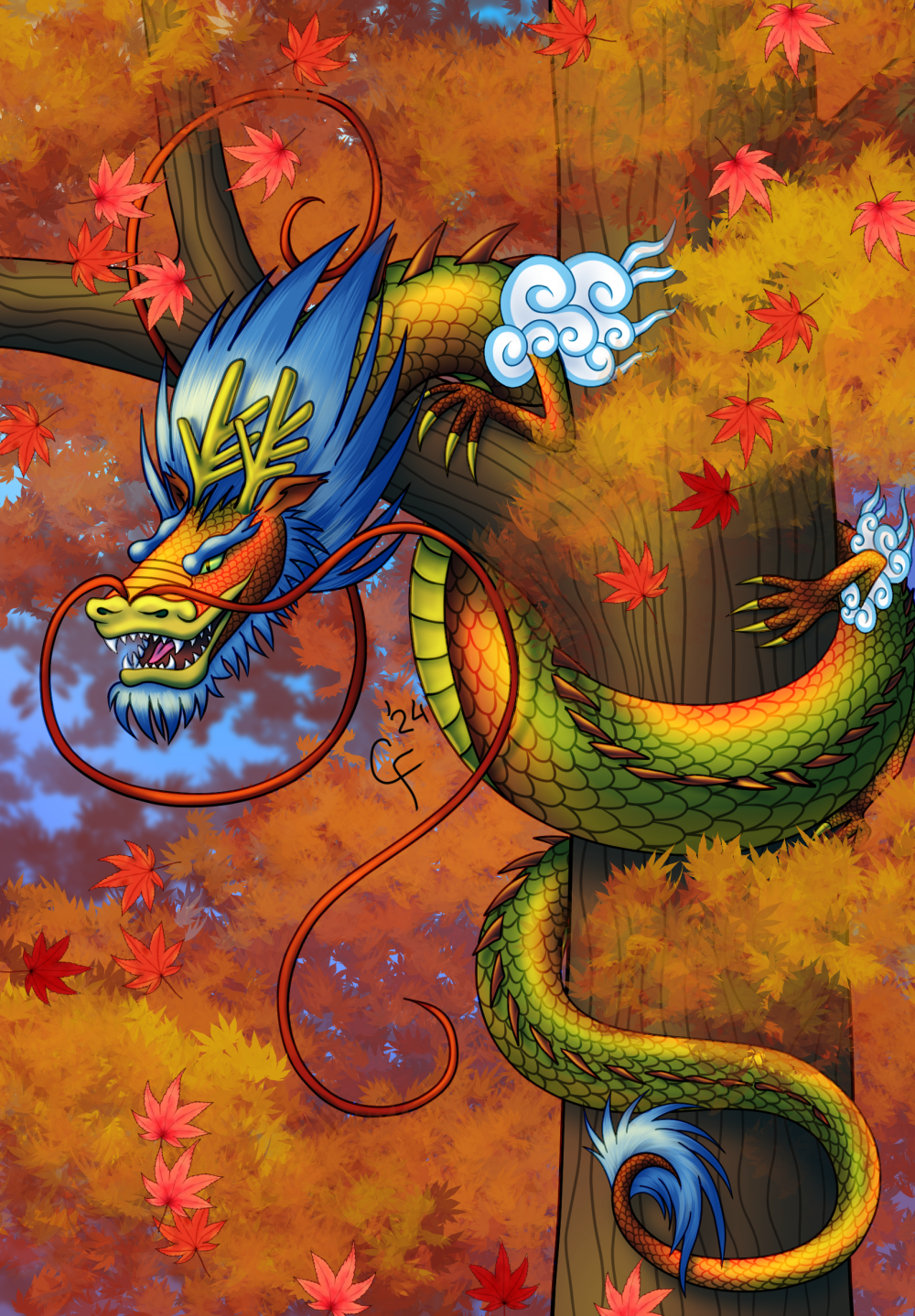
New art: Meeting
Still enjoying making art on my iPad. For this drawing, I wanted to try some of the real media brushes in Clip Studio Paint—I went with chalk for most of this piece—and I thought a children’s book illustration style would suit the tools well.
I’ll draw something other than a dragon soon. Probably.

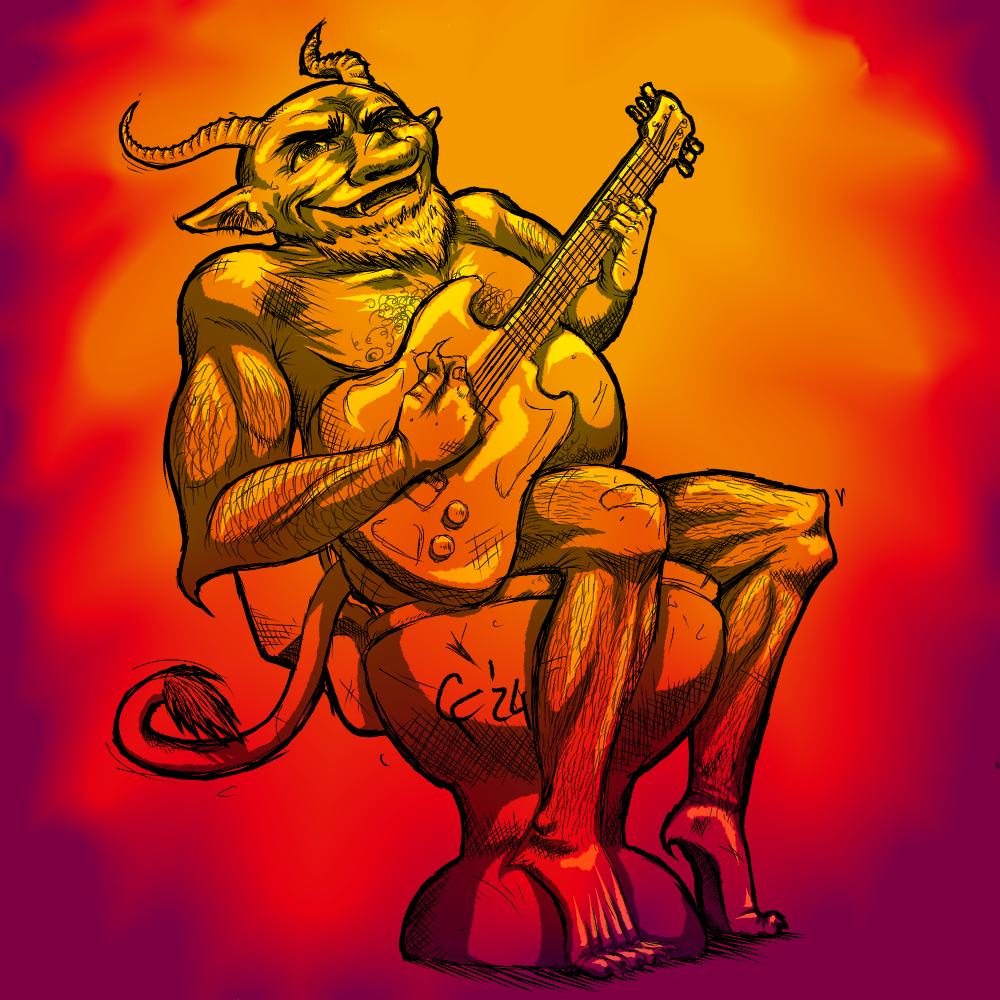
New art: Upon the Porcelain Throne
I drew the album art for musician Jett Swole‘s latest release, Upon the Porcelain Throne.
I… really enjoyed doing the messy style.
New art: Solstice
I had a couple of reasons for making my newest art. First was that I got an iPad and Apple Pencil and was eager to try out both for art. I also received a free trial of Clip Studio Paint Pro, which I’ve heard good things about and which looked quite promising from the information I’ve read about it. I’ve much more to learn still, but am really enjoying it already.
As to why I painted this picture, that’s a bit longer story. I saw a few posts online a year ago about the origins of the cuetlaxochitl—or as it’s more commonly known in the imperialist West, poinsettia—but only this season did I read up on its true history as a plant cultivated by and sacred to Aztec civilization (along with the sordid personality of its English namesake). Combined with my usual annoyance with the unchallenged sexism, racism, ableism, etc. of many “classic” holiday songs, I decided to make a painting that incorporated as many Christmas symbols co-opted from other cultures as I could (and which my limited Google-fu came up with). And because I’m me, I made it a dragon.
On a more personal level, I have not enjoyed making art this much in a long time. I wasn’t only pleased with how it was turning out, I loved the process of working on it. I am greatly looking forward to making more art on my iPad.
Anyway, here’s the completed piece:


Waiting for the other ball to drop
Honestly, 2023 is a year I’m not sorry to see the end of (hence my actually writing my year-end post before the calendar turns, for once). This was the year my health took a nosedive. The cancer was only the most dramatic issue; I had plenty other concerns that ranged from inconvenient to frustrating to affecting daily life.
But you’re not here to read me whinging about medical concerns, so let me move on to the rundown of this year.
Reading: I met my goal of reading 30 books this year in early October and have reached 38. Read several fun books, checked off a few that had been on the TBR for a while, and finally read books from some author friends I’ve met over the years. I also started diving into the many ebooks I’ve collected over the years. Mostly, the free downloads from authors I’m not familiar with have not grabbed me; I DNFed fourteen books on Kindle alone, mostly quite early in, but a few between 50-75% completed. No five-star reads this year. Top book: I’ll call it a tie between Black Sun by Rebecca Roanhorse and Daughter of the Moon Goddess by Sue Lynn Tan.
Writing: The big news here is that I completed the Sisters of Chaos trilogy with the release of Elderra’s Champion in June. While there are still a few short stories and a novella or two from the same world that I wouldn’t mind getting out, I’m quite happy to move on. That said, radiation tanked my motivation and I haven’t done much writing in the second half of this year. I did start a new (standalone) novel, but haven’t quite gotten traction on it yet, nor have I managed to finish some of the short stories I started or have been developing. I’ll have to just sit down and make myself write at some point, but I’ve been focusing on other hobbies of late.
Art: Although I did very little art for fun, I did enjoy the excuses I had to play with new/rarely-used media. I’ve also finally cleaned off my art table so it can once more be used for its intended purpose, and picked up some supplies that I’ve considered for a long time. (In other words, I may finally be a kneaded eraser convert.) I’ve been more into art the last month or so of this year, particularly since I got an early Christmas gift of an iPad, an Apple Pencil, and Clip Studio Paint Pro. I have really been enjoying that combination and hope to have a rather fancy new piece to share before end of day tomorrow.
Video games: The stress/exhaustion of radiation had me enjoying these a bit more this year, particularly The Legend of Zelda: Tears of the Kingdom, which I sank over 270 hours into, more than any other game I’ve played. I think I still added more games than I completed, but I did play (or at least attempt) a couple I’ve been considering for a while and have delved into the Kingdom Hearts universe. Working on KH2 at the moment and am interested enough to spend the money to add the games I don’t have. As a fan of Final Fantasy, Legend of Zelda, and other non-connected/non-linear game series, I’m finding the ongoing storyline quite interesting. Top game: Tears of the Kingdom, of course.
Music: Another hobby that suffered the lack of time and motivation from the cancer treatment. I’ve even cancelled my subscription to the app I was using to learn guitar, piano, and ukulele. Still interested in learning them, but not prioritizing it.
TV/Movies: …yeah, I think I’m done with these. Attempted to watch a couple shows but just not interested enough to sit down and do it. Watched a couple new movies at others’ behest and felt very meh about them. I don’t even want to re-watch the movies and shows I used to enjoy all the time. I’d rather spend my time doing one of the above instead.
Photography: Continues to fall off, with possibly the fewest pictures taken this year since I first got a digital camera twenty years ago (with its all of 2 megapixel resolution and maybe 64 MB memory card). That said, if I don’t need the telephoto lens, my phone camera does a pretty fine job with photos, getting crisp colours, higher resolution photos than my DSLR, and some fantastic picture modes including portraits, panoramas, slow motion and time-lapse video, and built-in 3X optical zoom. So I am still flexing my photography skills (beyond funny cat pictures). I’m just terrible at sharing them.
In a nutshell? Well, cancer defined a significant portion of my year. While some interests did languish and perhaps I did more passive hobbies like reading and playing video games, I’m not disappointed with my productivity this year.
As for 2024, well. I swore off resolutions years ago, but I think I’m even going to eschew goals for most endeavours this year. I will indulge playing instruments, watching TV, baking, and more if I feel like it. It would be nice to have a new book ready by the end of the year, but I’ll let inspiration with writing, and art, flow as it will.
I do these things for fun, after all. Perhaps that should be my goal for 2024: just enjoy myself.
…although I’ll still set another goal of reading 30 books this year.

Is he strong? Listen, bud…
I’ve had people requesting updates on my cancer treatment, so I thought I’d give one here.
For those who only follow this blog, I spoke prematurely when I said that my diagnosis was not going to be a significant impact on my health: shortly after I made my previous post, the doctors decided that I needed radiation.
There’s… a lot I could say about it. (I got a “So you have cancer” packet of pamphlets and information from the hospital. It’s half an inch thick. I summarized the important parts in a notes file on my phone, which is still three pages long.) Side effects, things I have to do, measures (and medicines) I might need to take, what I need to have on me at all times, how to cope physically and mentally, and on and on.
However, I doubt most people are interested in the minutiae, so I’ll just paint a picture of what radiotherapy looks like.
When I’m called back from the waiting room in the second basement, I take a brief walk to the treatment room, which doesn’t look much different from any other hospital procedure room. I don’t change into a gown; an open-collared shirt suffices for where I’m getting the radiation. I recite my birth date, the radiation therapists ask how I’m getting on, if I have any new side effects, I take off my mask and glasses and such, and lie down on the treatment table, which, in the way of hospitals, is about the size and comfort level of an ironing board.
About a month ago, I had a CT scan during which a mesh mask was custom-fitted to me, by heating it up and having nurses press it down to conform it to my face and neck. It now has holes cut out for my eyes and mouth, as well as the treatment area, and the radiation therapists strap me down to the table with it. (It both prevents one from moving during the treatment and helps to pinpoint the location of the radiation.)
A gel pack is positioned over the treatment area to catch any stray ions, gaps between that and the mask are stuffed with paper, and after the therapists trade some medical jargon, they leave the room to the sound of an extremely digital clock tone. (You know, the classic bell song, like Big Ben makes on the hour?) Sometimes, the therapists need to come back in to make some adjustments to the gel pack or padding. Then, the large machine that dominates about a third of the room, all plastic and indecipherable screens, rotates a couple arms around me while I lie there. I feel nothing.
They play music in the room, usually oldies (as I begrudgingly admit the songs of my childhood are now). The actual treatment time takes about as long as “Bohemian Rhapsody”.
That’s it. The full session takes fifteen minutes, and the radiation department operates like a well-oiled machine. My appointments have never been late, and even when I am, I’m taken in quickly.
I started treatment two weeks ago, every weekday, and have now completed 1/3 of the course. So far, I haven’t had much in the way of side effects. I had a sore throat for a little while last Saturday, terrible dry mouth the following day, and had a headache after getting home from today’s treatment. I’m also getting quite tired at least once during the day, but it’s difficult to tell whether that’s new fatigue or the same that I’ve been fighting for the past few years. I haven’t needed the medicated mouthwash I was given for pain, let alone the liquid morphine.
However, the side effects are supposed to worsen as treatment progresses, and will continue to worsen or at least remain as bad for a few weeks after the treatment has ended, so I’m bracing myself for worse. On the bright side, radiation treatment has come a long way even in the last twenty years, so some aspects shouldn’t be as bad. I shouldn’t lose my hair, as an example.
The good news? It’s critical to maintain one’s weight during radiation therapy, so even if it becomes hard to eat, I have full permission to subsist on ice cream and add calories to other easy-to-swallow foods. Also, on a more personal level, I’ve been given a lot more leeway to play video games.
Ten days down, twenty to go. I got this.

The Big News
* This is just a stock photo. My blood pressure tends to be on the low side.
UPDATE June 29: It seems I spoke too soon when I said that this wouldn’t be a significant impact on my health.
It’s been an interesting spring. But let’s start a little earlier than that.
When I moved to Canada eighteen years ago, I’d had a lump in the base of my neck for a few years. I’d managed to ask a nurse at Planned Parenthood about it before I left the States, but there wasn’t much else I could afford to do about it. So, I anxiously awaited the day I attained permanent residence and could then get a health card.
The family doctor I got examined the lump and figured it wasn’t anything to worry about, but since I was concerned, he went ahead and referred me to a specialist who removed it. The biopsy afterwards identified it as a myxoma, a benign tumour that usually appears in the heart—in fact, I couldn’t find any information online about myxomas that weren’t in the heart. Weird, but it was gone.
Fast forward ten years or so. Another lump formed in the same place, right next to the scar from the previous surgery. I dawdled on getting our current family doctor to look at it. When I pointed it out, however, she immediately referred me to an ENT. Last December, I finally saw said specialist, who ordered a biopsy.
The fine needle biopsy was inconclusive. A bigger needle biopsy was ordered, with local freezing and an incision to try and get deeper into said lump. At the time (while I cringed from the pressure being put on the area beneath the freezing), the doctor performing the aspiration said that it just looked like scar tissue to him.
Great.
However, a couple weeks later, the ENT confirmed that there was evidence it was another myxoma, and I had it surgically removed… again.
Two weeks later, I had my follow-up, everything looked good, though the pathologist who biopsied the removed tissue found the myxoma strange (because yes?) and wanted permission to send a sample to Mt. Sinai hospital in Toronto for a second opinion. I could only smirk at that, especially after researching myxomas fresh and the only mention I could find of them appearing outside the heart was in a scholarly article published several years after my surgery which stated that those happened primarily in seniors and once removed didn’t recur.
How fun! I’m so special I’m a case study!
9:00 that night I get a phone call from the ENT. The pathologist called her back to let her know that it was not, in fact, a myxoma.
It was cancer.
Insert record scratch noise here. And cue the longest week of my life.
To be clear: this is a slow growing, very treatable type of cancer. It is not a countdown timer on my life, it’s not even a significant impact on my health (this type of cancer doesn’t really respond to chemotherapy so that’s not in the cards at all; surgery is the primary treatment method).
That said, the words you have cancer hit like a sledgehammer.
It’s like depression: it colours everything you do; it’s always lingering at the back of your mind, ready to tear apart your happiness at the worst moment; everything suddenly seems so much more urgent, yet so much more difficult; it makes it hard to sleep and even eat; it jumps in with intrusive thoughts no matter what’s on your mind (yes, but you have cancer). Reading about how treatable and non-aggressive this type of cancer is is very different from knowing from a single phone call that it’s sitting in there, doing its best to eat away at my body.
Over the twelve weeks since then, I’ve come to understand, on a fundamental, subconscious level, that it’s not anything to worry about. (And I don’t mean because there isn’t anything else I can do about it; it’s really not a serious health risk to me.) It’s just meant a lot of appointments, tests, and general trips into downtown Toronto.
Along with another surgery. That happened May 30 and tomorrow I can finally pick up my cat again (well, one of them; I’ve been giving the petite eight-pound girl more cuddles than she can handle). This week I’ll find out if radiation is necessary (or recommended), though the otolaryngologist is pleased with the results from the second surgery and thinks we can merely monitor it for now. I figure it’ll mean continuing follow-up appointments for probably at least a few years to come, and it may require another surgery to remove every last trace of it.
For the curious, it is a low grade fibromyxosarcoma. A sarcoma is a soft tissue cancer (that of fat, muscles, nerves, etc., and apparently also bone somehow?) and low grade means slow growing. As far as I can tell, the fibromyxo part has no relation to anything other than this particular type of cancer (although it’s hard to miss the similarity to myxoma, which these types of cancers are often confused with). It also has an incidence of one in eight million. I am probably the only person currently being treated at Princess Margaret, one of the top five cancer centres in the world, for this particular type of cancer.
I really am special!
Whether the original tumour removed some twelve to fifteen years ago was misdiagnosed as a myxoma (and which would mean I have been living with untreated cancer for my entire adult life) or whether the myxoma became malignant, I may never know. The doctor hasn’t been able to obtain the slides from that biopsy. Given that it took four biopsies to identify this one properly, I wouldn’t be surprised if the first one was in fact the same thing.
I mainly wanted to write this to let people know why I’ve had to cancel plans or haven’t been able to get to some tasks as quickly as I would like, or why my output in general hasn’t been as high recently (well, that and the other health problems I’ve been dealing with concurrently, but that’s another story). I’ll be fine, and I wasn’t fishing for outpourings of empathy or assistance getting things done. (But hey, if you feel like buying a book, you’ll make my day.) I certainly have it far better than many, possibly most, people getting treated at Princess Margaret. I’ll get through this.
So, hi. My name is Catherine Fitzsimmons, and I have cancer.
Trilogy finale drops in one week!
As usual, I’ve failed to update this blog or promote myself, but next Friday, the final book of my Sisters of Chaos trilogy, Elderra’s Champion, is releasing.

You can preorder it to have it shipped now directly from the publisher (i.e. me, so you could even get it signed if that’s your thing) or from Chapters/Indigo, Barnes & Noble, Books a Million, Amazon, your local indie bookstore, or anywhere else you’d like.
I’m also having a Zoom launch party next Saturday, June 10. It’s an open call so feel free to come in with or without video or audio. It’s just going to be a casual hang out. Details and meeting link on the event page.
To those who have read any of the books over the years, thanks for your support. All I’ll say about what’s coming next is it ain’t gonna be epic fantasy.

New Year 2023
As usual, after months of silence, I return to this blog for my annual new year post. Maybe it’s my ongoing health issues, New Year’s Eve messing up my entire week so far, or coming up on the fourth year of the pandemic, but I’m not feeling particularly hopeful about 2023. I do, however, have good things to look forward to, including another 11 great books I’m going to publish this year.
First, a wrap-up of 2022:
- Books: While I didn’t read nearly as many as I did in 2021, I did surpass my goal of 30 to reach 35 books last year. I read more middle grade novels and graphic novels, but I also read some nonfiction and general audience novels. My TBR pile has built up again from a couple book sales and from my first trip to Gen Con since 2019, and I’ve also just dipped my toes into the many ebooks I’ve collected over the years. Top book from the year remains Project Hail Mary by Andy Weir.
- Video games: I added more than I completed and had a fairly long break throughout summer and autumn, but I did start and finish a handful of games. I enjoyed Metroid Dread. I played the original Legend of Zelda for the first time. Two things that struck me about it was how the future games are very much a continuation/extrapolation of it, and how open-world the first game is. I haven’t officially pulled the plug on God of War (2018), but I beat the storyline and there’s one optional boss I’m going to try one more time (after which is another optional boss that will probably murder me). Top game: Spider-Man (2018).
- TV/Movies: Disney+ was our only streaming service until a month ago, so any new media was focused there. Watched most of the new Marvel and Star Wars series and finally started getting burned out on both. Heard good things about Andor and She-Hulk but just haven’t dredged up the interest; same with the newest Marvel movies. I’d rather read or just watch YouTube. However, we got Netflix in December and I’ve started watching a few series there. That said, we are not binge-watchers and Netflix’s tendency to encourage it annoys me. It’ll probably be a few months before I finish these. Top show: Stranger Things.
- Writing: Eventually finished initial edits on Elderra’s Champion, the third book of my Sisters of Chaos trilogy, and got feedback from both beta readers. Some fairly significant edits still to do, but I’ve tried to ramp up my production on them. I also somewhat spontaneously wrote a short story, the first >1,000-word story I’ve written in a few years, and particularly original one that’s not a tie-in to one of my novels. I also started writing a new novel while Elderra’s Champion was off with beta readers.
Other endeavors fell off a bit this year. While I did a new acrylic painting for the first time in years, I otherwise haven’t really done any drawing in months. I’m slowly continuing to learn/practice guitar and piano, recording some of the latter for collaborations with a couple musicians. Also, at the very end of the year, I decided to try out my child’s ukulele, and it turns out I love it. I also started seeing people and doing events again this year, both of which have been so nice, even if I still mask up every time I go out.
So, what’s ahead for 2023? I don’t have goals for most of the above; I don’t care about watching more TV, even if I am enjoying some series, and video games are too varied to make goals for completion there. I miss reading when I’m focused on video games and I miss gaming when all I do is read. So, I’m going to continue setting a goal of 30 books this year, and I will likely get more into my ebook TBR as well.
As for writing, finishing Elderra’s Champion is not a goal anymore; as of Friday, it will be officially coming in June. I was hoping to be finished with my edits by the end of 2022, and may honestly be continuing to tweak down to the first printing (publisher privilege). Beyond that, as mentioned, I already have another novel on the go, though I also have several short story ideas that have been percolating for a few years that I’d love to get down as well. It would be nice to start releasing stuff more regularly, but hey, as long as I make that June release, I met my goal of halving the release time between books 1 and 2.
Once again, I’d like to practice my instruments more regularly (and perhaps try not to be too intimidated by those lessons). Art I will continue to let come as it comes. As for visiting people/attending events more often? It sure would be nice.
For now, I’m just hoping to recover from that one late night soon. Happy new year and I hope 2023 brings you all the joy and luck you deserve.


 Jinxed